
Last night we were out to dinner with friends, still riding the high of our driftwood post. Somewhere between the appetizers and the check, one of them said, "Okay, you did wood — now do rocks."
So here we are. Below, we'll walk you through the best rocks for a freshwater aquarium — what helps, what hurts, and what to leave on the shelf.
Rocks are one of the easiest ways to turn a plain glass box into a natural-looking freshwater habitat. They add height, structure, hiding places, and surfaces for plants to grab onto. But they also do something most beginners don't expect: some of them quietly change your water. And that's the whole reason we're writing this.
Here's the big idea, and if you remember nothing else, remember this one. The question is almost never "Is this a good rock?" The better question is, "Is this rock right for this tank?" A stone that's perfect for an African cichlid setup can work against a soft-water tank full of tetras. Rocks aren't good or bad. They're tools, and the trick is picking the right one for the job.
What Rocks Actually Do for Your Fish
Rocks earn their spot for more than looks.
They give fish a sense of security. Caves, gaps, and overhangs give shy fish somewhere to retreat, and here's the part people find backwards: a fish with a safe place to hide usually spends more time out in the open, not less. Confidence comes from having an exit.
They also help settle arguments. With cichlids and other fish that have opinions about real estate, a good rock layout breaks up sight lines and hands each fish its own corner of the tank. Fewer squabbles, calmer aquarium.
On top of that, every rough surface is prime real estate for the beneficial bacteria that keep your water clean — lava rock especially, since it's basically a sponge made of stone. And a few well-placed rocks give plants like Anubias, Java fern, Bucephalandra, and moss something to anchor to. A couple of strong pieces almost always look better than a scattered pile of pebbles.
The Two Rock Groups Every Beginner Should Know
Forget the scary lists for a minute. Almost every aquarium rock falls into one of two buckets, and knowing which is which does 90% of the work.
Inert rocks don't meaningfully change your water. Stack them however you like — your pH and hardness stay put. These are your safe default for most community tanks, planted tanks, shrimp tanks, and any soft-water setup.
Reliable inert choices: lava rock, Dragon Stone, slate, granite, basalt, quartz, quartzite, and most smooth river rock (as long as you know what it actually is).
Calcareous rocks contain calcium carbonate. They dissolve slowly, adding minerals that raise your water's hardness and nudge pH upward.
Common calcareous rocks: limestone, Texas holey rock, coral rock, shell-based rock, marble, aragonite, Seiryu Stone, and some pagoda, elephant skin, and dolomite-type stones.
Again — calcareous isn't a dirty word. For Rift Lake cichlids, livebearers like guppies and mollies, and other fish built for harder, alkaline water, these rocks are a feature. For a soft-water or blackwater tank, they're working against you. Same rock, opposite outcome.
The Best Rocks for a Freshwater Aquarium: Our Go-To Picks
For the majority of tanks that come through our door, the best rocks for a freshwater aquarium are the dependable workhorses below:
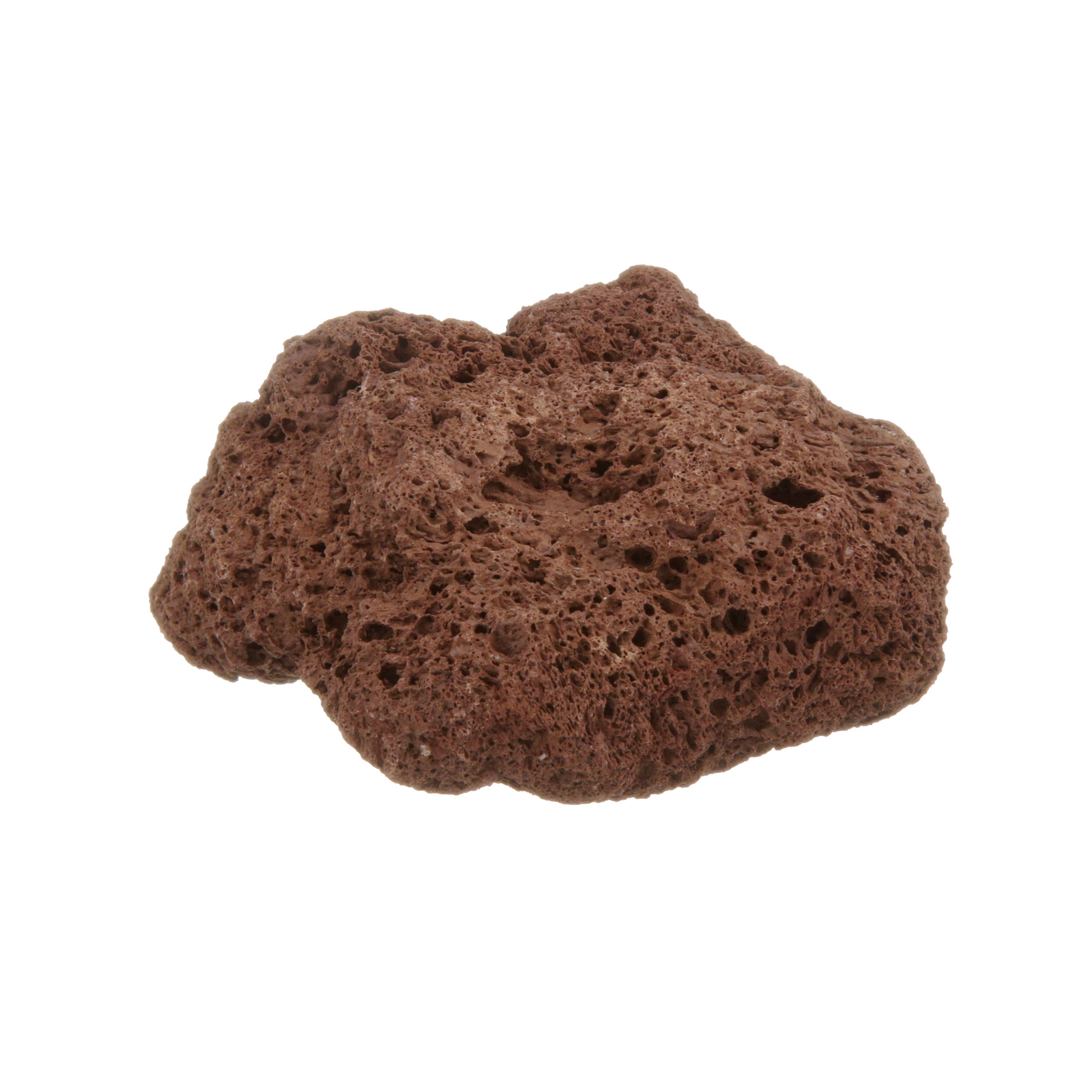
Lava rock — Lightweight, porous, and endlessly useful. Great bacterial surface, great cover for shrimp and fry, and moss and Anubias attach to it beautifully. One heads-up: some pieces are sharp, so pick smoother chunks near fancy goldfish, bettas, corydoras, and loaches.
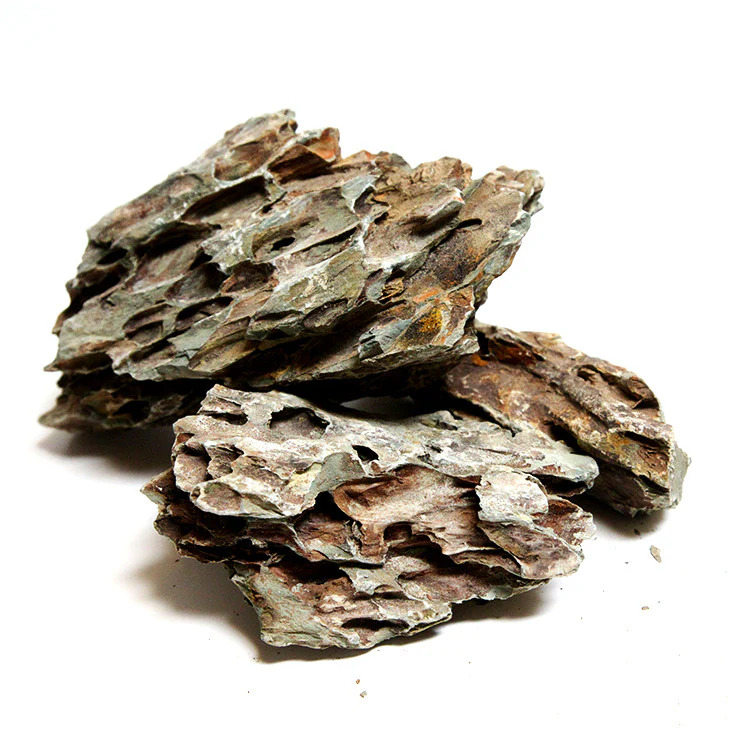
Dragon Stone (Ohko) — A planted-tank favorite, full of holes and pockets that make natural-looking layouts easy. Rinse it well — clay and dust love to hide in those crevices.
Slate — Flat, layered, and stackable. Perfect for caves, ledges, and vertical backdrops. Use solid pieces and keep the thin, sharp shards away from bottom-dwellers.
Quartz and quartzite — Hard, durable, and neutral. When you want rock without touching your water chemistry, this is the easy answer.
Granite and basalt — Dense, solid, and low-risk on chemistry. Clean, natural look. Just place the heavy pieces carefully.
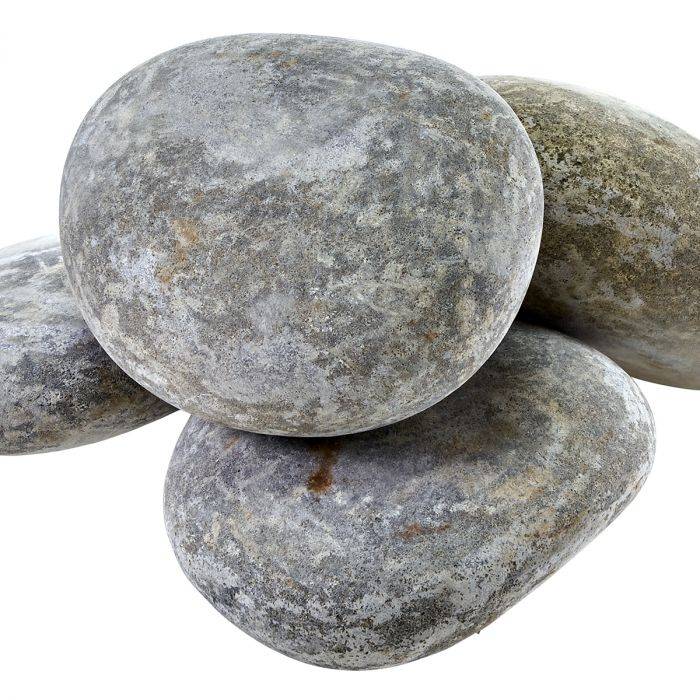
Smooth river rock — Gentle on fish and lovely around corydoras and loaches. The only catch isn't the shape — it's knowing what the stone is made of, since some are neutral and some are secretly calcareous. When in doubt, test it (more on that below).
When You Want a Rock That Hardens Your Water
Sometimes raising hardness is the goal. If you're keeping Rift Lake cichlids, livebearers, or anything that thrives in hard, alkaline water, calcareous rock does you a favor.
Texas holey rock is the classic here — it builds cave-riddled cichlid cities and raises hardness at the same time. Limestone does similar work. Coral rock and aragonite add carbonate and are handy when you want that mineral support. In a soft-water planted community tank, though, use these with intention, not by accident.
Seiryu Stone: Gorgeous, But Not Neutral
Seiryu deserves its own note, because it's one of the most popular aquascaping stones on the planet — those sharp gray lines make instant miniature mountains — and it's also one of the most misunderstood.
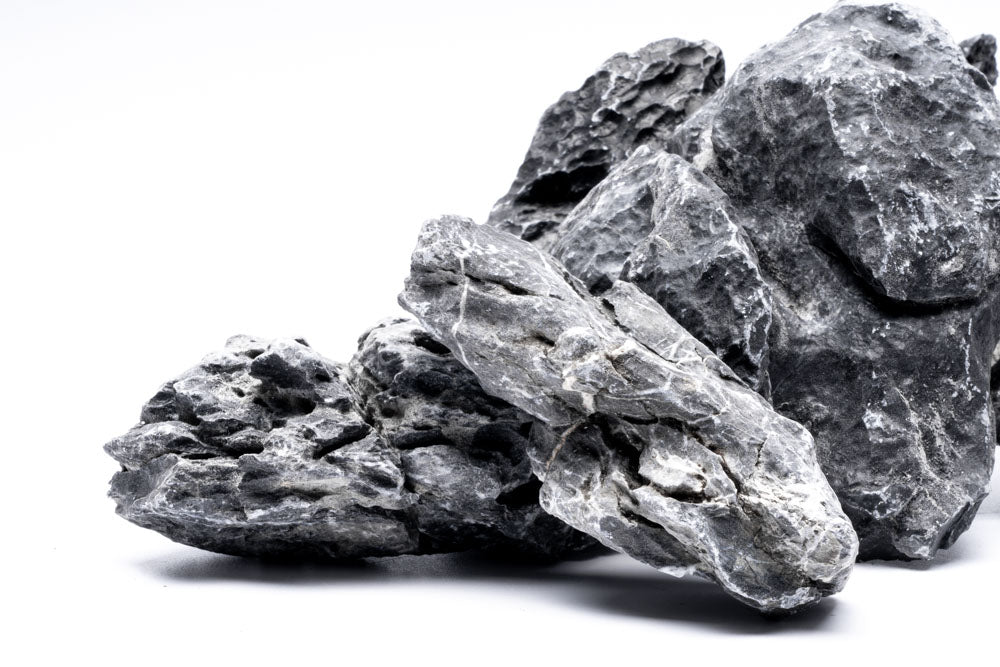
Despite what some listings claim, real Seiryu typically contains calcium carbonate. Over time it raises KH and GH, and in many tanks it pushes pH up too. That doesn't mean avoid it forever. It means go in with your eyes open, and be especially careful with it in shrimp tanks, soft-water and blackwater setups, tanks with apistogramma, chili rasboras, or wild bettas, and small aquariums where changes hit fast.
If a vendor swears their Seiryu is "pH neutral," they may be selling a neutral lookalike. Either way, the answer is the same: test it before you trust it.
What If You Want Softer Water?
Here's a question we get all the time: is there a rock that lowers pH? Short answer — no. There isn't a stone you can drop into a tank that meaningfully softens your water or lowers the pH. Rocks either sit there quietly or push hardness up. None of them pull it the other way.
If softer, more acidic water is your goal — say you're chasing a blackwater biotope or breeding wild bettas — that's a job for driftwood and nutrient-rich aquasoil, not stone.
Our post on aquarium driftwood walks through how wood releases tannins and gently nudges pH down.
One honest note on geography: here in Oklahoma, most tap water already runs on the harder side, so if you're shopping with us in Broken Arrow, calcareous rock usually isn't going to be your make-or-break — your water is starting there anyway. But if you're reading this from a soft-water part of the country, matching your rock to your water is exactly where all of this pays off.
How Rocks Can Cause Trouble
Rocks are one of the safer things you'll add to a tank, but they cause problems in five predictable ways. Know them and you've dodged almost all of them.
They change your water. The big one. Calcareous rock raises hardness and pH — great for some fish, stressful for others. Know your fish and test your water before you commit.
They trap gunk. Tight piles of rock collect food, waste, and debris. Leave room for flow and for your gravel vac to reach.
They fall. A toppling rock cracks glass and crushes fish. Set heavy pieces on the bottom glass before you add substrate around them — never balance rocks on loose gravel.
They cut. Sharp edges are hardest on long-finned fish, goldfish, corydoras, loaches, and plecos. If a rock feels sharp in your hand, it feels sharp to a fish.
They come from the wrong place. A stone from a clean creek is a world apart from one off a roadside, parking lot, treated lawn, or construction pile — those can carry oil, fertilizer, pesticides, or road salt you'll never scrub out.
The Short List of Rocks to Skip
The internet loves a long, frightening avoid-list. The real one is short. Steer clear of:
Copper and metal rocks — malachite, azurite, anything with copper-green mineral streaks, or metallic ore specimens. Copper is toxic, especially to shrimp and snails.
Coated, painted, or dyed stones — if water beads up instead of soaking in, it's been oiled or sealed. Pass.
Man-made rubble — concrete and construction debris carry unknown chemistry.
Anything from a dirty collection site — see trouble #5 above.
That's basically it. Everything else is a matter of inert vs. calcareous, not safe vs. deadly.
Two Ways to Test a Rock
The vinegar test is your quick screen. Drip a little vinegar on a dry spot and watch for fizzing. Bubbles mean carbonate, which means the rock will raise your hardness — not that it's toxic. Just know that vinegar is weak, so a quiet rock can still be mildly calcareous. Fizz is a "yes," but no fizz isn't a guaranteed "no."
The bucket test is the more honest answer. Fill a bucket with your tank water, test the pH, GH, and KH, drop in the cleaned rock, and check the numbers again after several days. If hardness climbs, the rock is changing your water — and now you get to decide whether that helps or hurts the fish you have in mind.
Don't own a GH/KH kit? That's exactly what we're here for. Bring the rock, or a sample of your tank water, into the store and we'll test it with you and tell you straight what it'll do.
How to Prep a Rock (It's Easy)
Prep is simpler than the internet makes it sound. Scrub the rock under plain running water with a clean brush to knock off dust and loose dirt. Rinse Dragon Stone thoroughly — clay hides in the pockets — and give lava rock longer than you'd think, because dust buries itself in the pores.
That's the whole job. Skip the soap, skip the cleaners and sprays, and skip the boiling — it doesn't help, and dropping a cold rock into boiling water can crack it. The goal is clean, not sterile.
Our Rule of Thumb
Pick the rock for the fish first, the eye second.
For most planted and community tanks, start with inert stone — Dragon Stone, lava rock, slate, quartzite, granite, or basalt. For hard-water fish, calcareous rock like limestone, Texas holey rock, coral rock, and aragonite is doing real work. For soft-water fish, keep the hardness-raising rocks out of the tank unless you've chosen them on purpose.
A rock isn't just décor. Once it's underwater, it becomes part of the environment your fish live in. So if you're ever unsure, bring us a photo, a sample, or your water test results. We'd genuinely rather help you match the rock to the tank than watch you learn it the hard way.
Frequently Asked Questions About Aquarium Rocks
How do I know if a rock is safe for my aquarium?
Most natural rocks are safe. Check two things. First, does it change your water? Drip vinegar on it — if it fizzes, it contains carbonate and will raise your hardness and pH. Second, is it clean of metal, copper-green streaks, paint, or oily coatings? An inert, uncontaminated rock is tank-safe. When you're not sure, bring it by the store and we'll test it with you.
Should I boil my aquarium rocks?
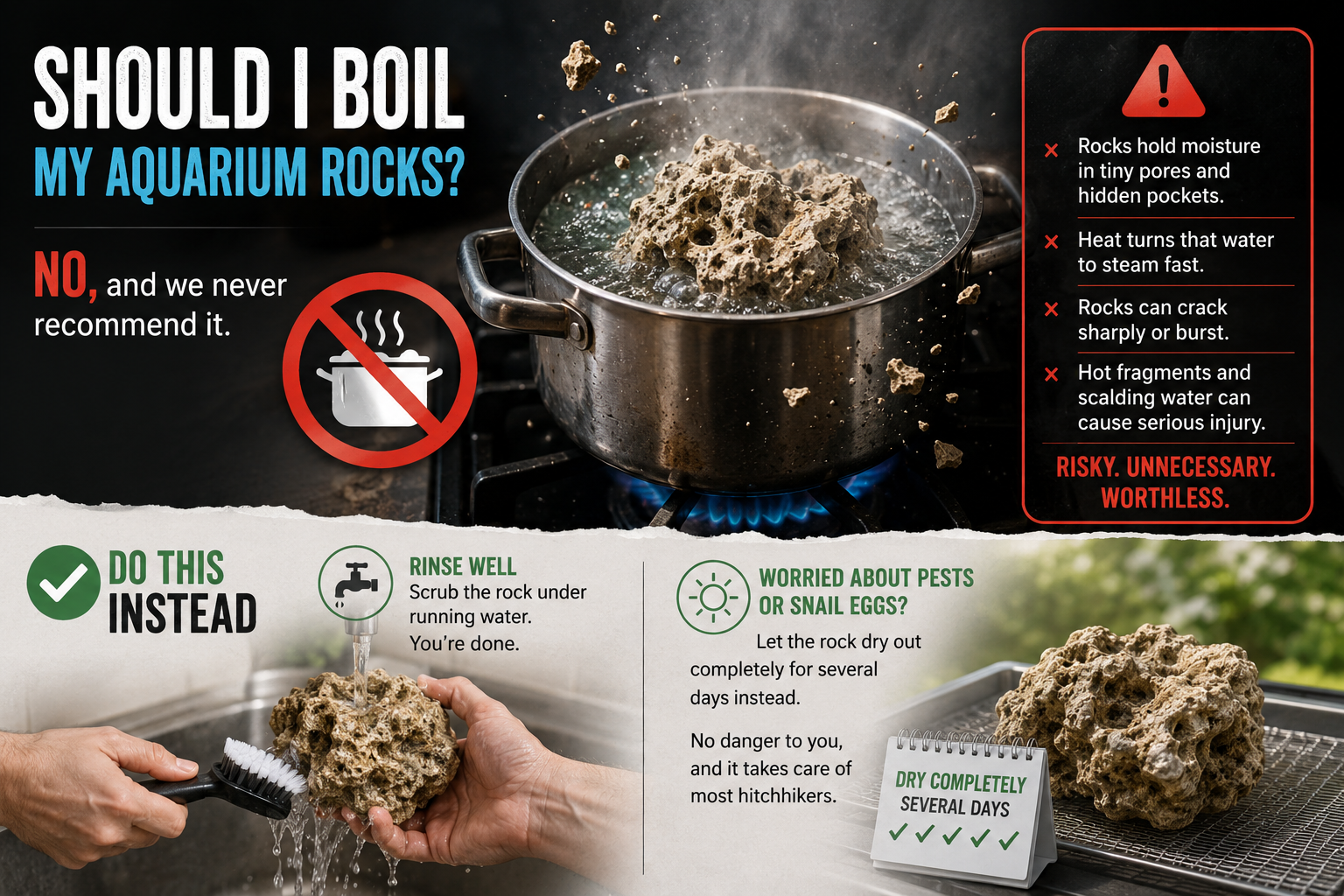
No, and we never recommend it. This is the question we get more than any other, and it's the one where bad advice can actually hurt you, not just your tank. Rocks hold moisture in tiny pores and hidden pockets. Heat that water quickly and it flashes to steam, which can make the rock crack sharply or even burst, throwing hot fragments and scalding water. That's a real injury risk, and boiling buys you nothing a rinse doesn't. Scrub the rock under running water and you're done. If you're worried about pests or snail eggs hitching a ride, let the rock dry out completely for several days instead — no danger to you, and it takes care of most hitchhikers.
Can I put rocks from my yard or a creek in my aquarium?
Usually, yes — as long as they come from a clean natural area. Scrub off the dirt under running water, no soap. Avoid rocks collected near roadsides, parking lots, treated lawns, or construction sites, which can carry oil, fertilizer, pesticides, or road salt you can't rinse away.
What does it mean when a rock fizzes in vinegar?
Fizzing means the rock contains calcium carbonate, so it will slowly raise your water's hardness and pH. It does not mean the rock is toxic. That fizz is useful information: it's a green light for hard-water fish like African cichlids, but a reason to skip the rock in soft-water or shrimp tanks. Keep in mind vinegar is weak, so a quiet rock can still be mildly calcareous.
Do aquarium rocks change the pH of my water?
Some do. Calcareous rocks like limestone, Texas holey rock, coral, and Seiryu release carbonate and push pH and hardness upward. Inert rocks like lava rock, Dragon Stone, slate, and quartz leave your water alone. Neither type is bad — the right choice depends entirely on the fish you keep.
Can any rock lower my aquarium's pH?
No. There's no rock that meaningfully softens water or brings pH down. To go that direction — for a blackwater tank or soft-water fish — you'll want driftwood and nutrient-rich aquasoil instead. Our aquarium driftwood post explains how wood releases tannins and gently lowers pH.
What are the best rocks for a beginner aquarium?
Start with inert rocks that won't touch your water chemistry: Dragon Stone, lava rock, slate, quartzite, granite, or basalt. They're forgiving, easy to build a natural layout with, and safe in almost any community or planted tank.
Is Seiryu stone safe for a planted or shrimp tank?
Seiryu is safe, but it isn't neutral. It contains calcium carbonate and raises KH, GH, and often pH. That's a plus in a hard-water setup, but in a shrimp tank or soft-water planted tank it can cause trouble. Test it in a bucket first, and be skeptical of any Seiryu labeled "pH neutral" — it may be a lookalike stone.
Happy Fishkeeping,Ray & Michelle