
Rummynose Tetras are some of my favorite tetras in this hobby, and I'll admit it up front: it starts with that face. That bright red nose has always reminded me a little of Rudolph, except instead of guiding a sleigh, this one's guiding a tight little school through driftwood and plant stems. Pair that red nose with a black-and-white checkered tail that looks like a tiny racing flag, and you've got one of the most striking small fish you can put in a freshwater tank.
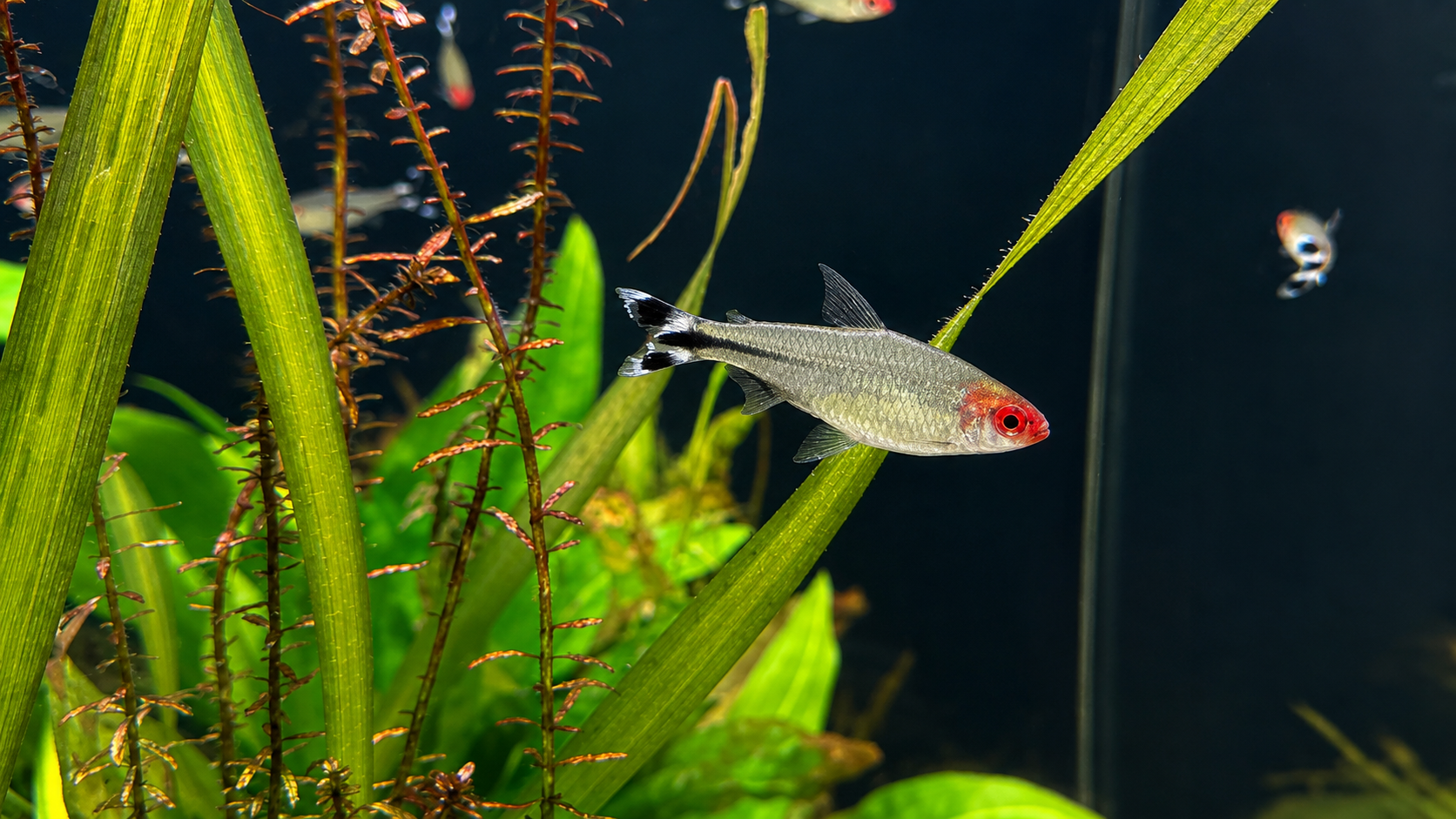
But the look isn't even my favorite part. My favorite part is how they move.
A good-sized group of Rummynose Tetras doesn't just occupy the same water. When they're comfortable, they move as one — turning together, pausing together, drifting through the scape like a single organism made of a dozen little red-nosed fish. Watching that happen in a well-planted aquarium is one of the coolest things freshwater fishkeeping has to offer, and it never really gets old for me, even after decades in this hobby.
There's also a practical side to that red nose that I appreciate as much as the looks. Rummynose Tetras are sometimes called the "canary in the coal mine" of the aquarium hobby. Old-time miners carried canaries underground because the birds reacted to dangerous gas before humans could detect it. Rummynose Tetras have their own version of that early warning system — that red coloration tends to fade when something in their world isn't right.
I want to be careful here, though, because this gets oversimplified a lot. A pale nose does not automatically mean your ammonia, nitrite, or nitrate is high. It's a signal to go investigate, not a diagnosis. Shipping stress, temperature swings, illness, aggression from tankmates, recent acclimation, even lighting can all cause that color to wash out. Treat a faded nose as a question, not an answer.
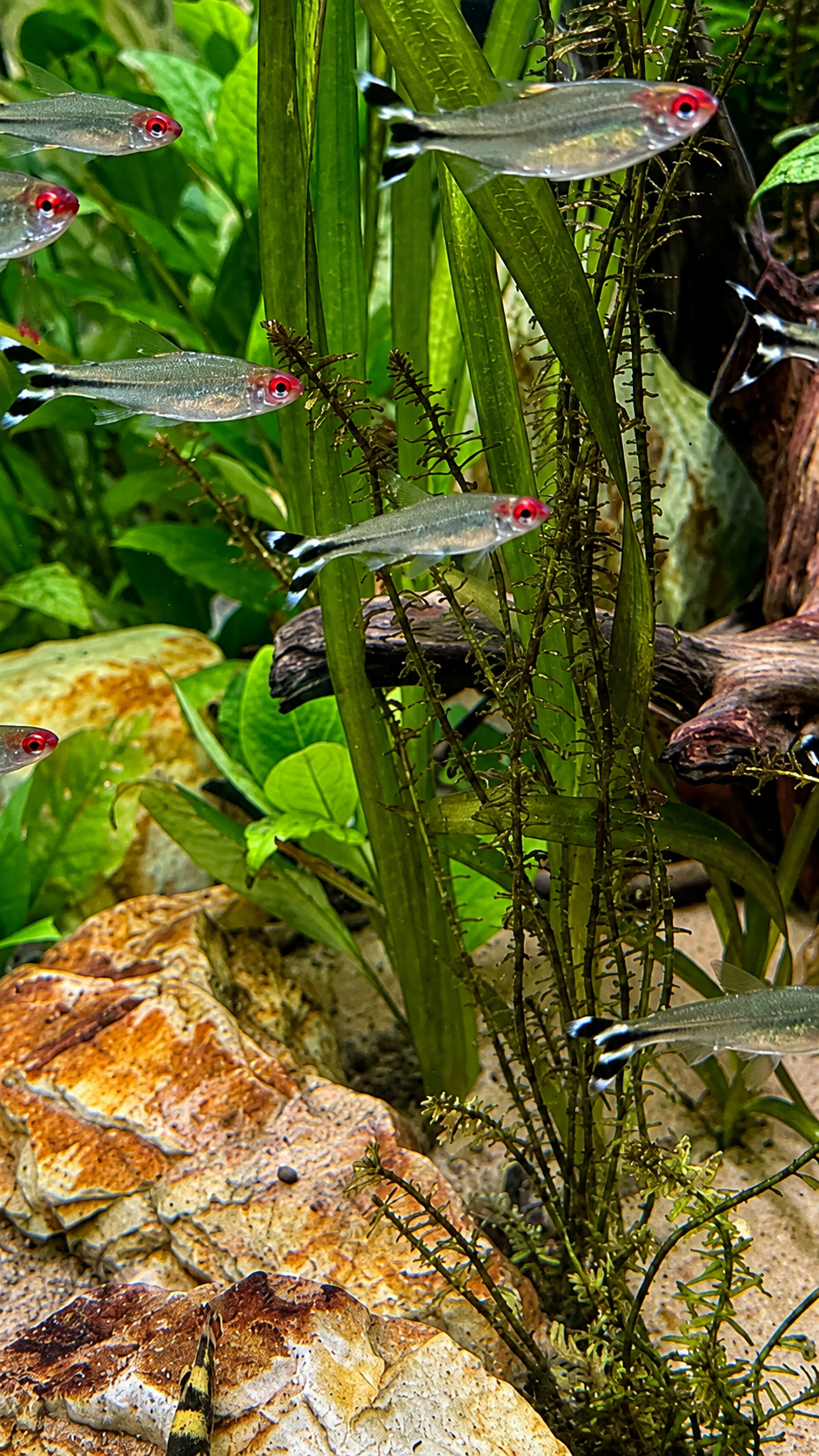
I'll also be upfront about the one real downside of this fish: Rummynose Tetras have a reputation for being a little fragile, especially during shipping and in the first few days after they arrive somewhere new. It's a fair reputation, and I'll get into exactly why later in this article — because understanding it changes how you should shop for them and what you should expect once they're home.
Let's get into the whole picture.
Rummynose Tetra at a Glance
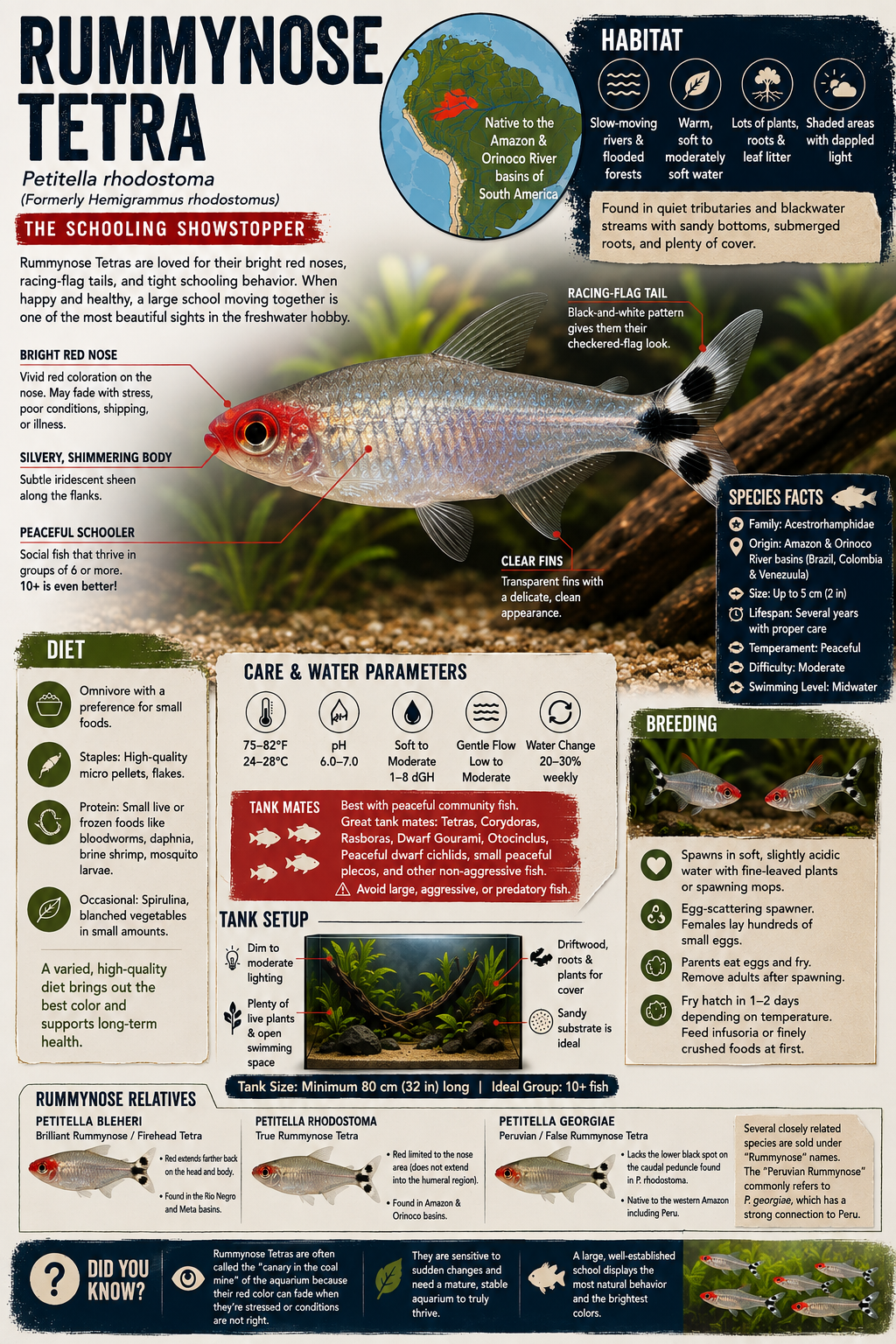
Scientific name: Petitella rhodostoma — for decades this fish was known as Hemigrammus rhodostomus, and you'll still see that older name on plenty of care sheets and store labels. A 2020 taxonomic study moved all three "rummynose" species into the genus Petitella, so Petitella rhodostoma is the currently accepted name, but don't be surprised to see the old one around for a while yet.
Common names: Rummynose Tetra, Rummy Nose Tetra, Red-Nosed Tetra, Firehead Tetra (more properly the related species Petitella bleheri)
Adult size: Right around 2 inches (5 cm), with some sources listing up to 2.5 inches. Size varies a bit between the three closely related rummynose species.
Typical lifespan: 5-6 years with good care and a stable, established aquarium
Temperament: Peaceful, highly social, built for a community tank
Recommended minimum tank size: 20 gallons, and I'd lean toward a "long" footprint over a tall one — more on why below
Recommended school size: 6 is a workable minimum, but I consider that a floor, not a target. 8-10+ is where this fish really starts to shine
Temperature range: Roughly 74-82°F. Sources vary a bit on the exact edges, but staying in the mid-to-upper 70s is a safe, comfortable range
pH range: 5.5-7.0, on the soft and acidic side
GH/KH considerations: They come from soft, low-mineral blackwater and clearwater habitats, so lower general hardness suits them best. They're not nearly as demanding as some soft-water specialists, but extremely hard tap water is worth addressing before stocking a big group
Diet: Omnivore — small flakes, micro pellets, and frozen foods
Swimming level: Middle of the water column, constantly active
Difficulty level: Moderate. Not because they're hard to keep long-term, but because they can be sensitive during the shipping and acclimation window
Geographic origin: Amazon Basin, primarily the lower Amazon in Brazil, with populations extending into the Orinoco system in Venezuela and Colombia depending on which of the three rummynose species you're looking at
Why Rummynose Tetras Are Such Great Schooling Fish
A lot of fish get called "schooling fish" pretty loosely in this hobby. Plenty of species will tolerate being kept in groups without actually schooling in any meaningful way — they'll hang out in the same general area of the tank without much coordination.
Rummynose Tetras are different. This is a fish that genuinely schools, meaning the group swims together with real coordination — turning as a unit, holding formation, reacting to each other in real time. It's one of the tightest, most consistent schooling behaviors you'll see in a freshwater tank, and it's a big part of why aquascapers reach for this fish specifically when they want that "river of fish" effect moving through a planted layout.
Here's where I'd push back on how a lot of care sheets frame this fish: six is treated as the standard recommendation almost everywhere you look, and technically it works. Six Rummynose will school. But six is a practical minimum, not an ideal target. This is a fish whose whole appeal is built on group behavior, and that behavior gets more impressive, not just marginally better, as the numbers go up. A group of 10, 12, 15, or 20 in a tank with the room and filtration to support it is a genuinely different visual experience than six fish drifting through a 20-gallon.
That said, I'm not going to tell you to overstock a tank just to make a prettier school. Bigger groups need bigger, better-filtered aquariums with the bioload capacity to match. If your tank can comfortably support 20 Rummynose along with everything else in it, go big. If it can support 8, then 8 well-cared-for fish beats 20 crowded ones every time.
The Red Nose: Your Aquarium's Warning Light
Let's dig into the canary-in-the-coal-mine idea a little more, because I think it's genuinely useful once you understand its limits.
That vivid red coloration across the head is tied to the fish's overall condition and stress level. When a Rummynose is comfortable, healthy, and settled, the red is usually bold and consistent across the whole school. When something's off, that color can fade — sometimes on one fish, sometimes across the whole group.
The mistake I see hobbyists make is jumping straight to "ammonia spike" the moment they notice pale noses. Sometimes that's exactly right. But there's a longer list of things worth checking when an established school suddenly looks washed out:
Ammonia and nitrite (always worth ruling out first in a newer tank)
Nitrate creeping up over time in an older, more mature tank
A temperature swing, up or down
A pH shift, especially a sudden one from a big water change
The water change itself — timing, volume, and dechlorination
Equipment problems — a failing heater or filter
Poor oxygenation, especially in warmer water or a tank that's overdue for a filter cleaning
Aggression or bullying from a tankmate you might not have noticed
Disease or parasites
Anything else that recently changed — new fish, rearranged decor, a new light schedule
Color alone doesn't diagnose the problem. It tells you to go look. Test your water, watch behavior, check your equipment, and think about what's changed recently. Most of the time you'll find something specific; sometimes it's simply a fish that's still settling in after a move.
Tank Size and Aquarium Setup
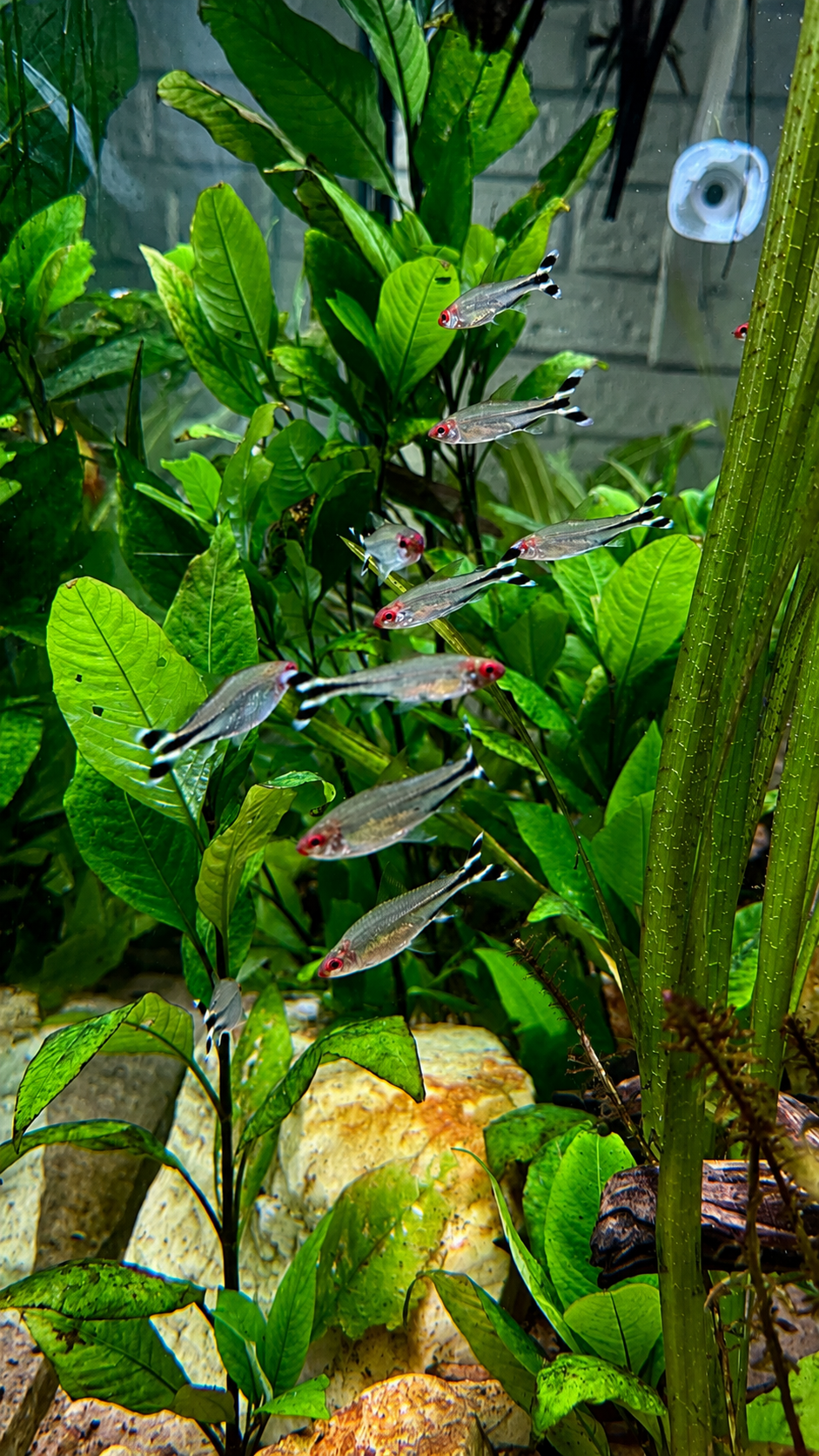
Rummynose Tetras want room to actually move as a school, which means horizontal swimming space matters more than tank height. A tall, narrow tank gives them vertical room they're not going to use much. A longer footprint gives that group somewhere to actually stretch out and demonstrate the behavior that makes this fish worth keeping in the first place.
The setup that gets the best out of them, in my experience, mixes cover with open water:
Live plants along the back and sides give the school a sense of security and something to weave through, and they help this soft-water species feel at home
Driftwood or aquarium wood adds structure, a little bit of tannin release if you want that blackwater aesthetic, and more visual interest for the fish to move around
Open swimming areas in the middle of the tank are non-negotiable — this is where you'll actually watch the school do its thing
Filtration should be solid and consistent; these fish appreciate stable water more than almost anything else you can offer them
Water movement that's moderate rather than a torrent — enough to keep water circulating and oxygenated without constantly buffeting a small fish
Lighting on the moderate side tends to bring out their color better than something blasting full intensity
Substrate doesn't need to be anything specific for this species, though a darker substrate tends to make that red nose and the silver body pop visually
Planted aquariums are where this fish looks and behaves best. It's not just an aesthetic preference — plants replicate the vegetated, slower-moving water they come from in the wild, and a planted tank gives the school natural landmarks to organize around as they move.
Water Parameters and Stability
Here's the short version: keep it stable, keep it soft-to-moderate, and don't overthink chasing an exact number.
Temperature: Mid-to-upper 70s Fahrenheit is a comfortable, well-supported range for most home setups
pH: Somewhere in the 5.5-7.0 range. You don't need to hit 6.0 exactly — you need consistency more than precision
GH/KH: Lower is better for this species, but if your tap water is moderately hard, don't panic. A gradual acclimation and a stable routine will get most Rummynose through it
Ammonia and nitrite: Zero, always, in an established tank
Nitrate: Keep it in check with regular water changes; older, heavily stocked tanks especially need attention here
The one thing I'd really stress is this: don't chase pH with chemical adjusters trying to hit some ideal number you read online. Constantly dosing pH up and down creates the exact kind of instability that stresses this species out and fades that red nose in the first place. A cycled, mature, consistently maintained aquarium with parameters in the right general range will outperform an unstable tank that's technically "perfect" on paper every time.
Before adding a group of Rummynose, make sure the tank is fully cycled and has been running long enough to be biologically stable. This is not a fish you want to be the first stocking decision in a brand-new setup.
Feeding Rummynose Tetras
These are small fish with small mouths, so food size matters. Good options include:
High-quality flakes, crushed a bit if the pieces are large
Small sinking or slow-sinking pellets sized for micro or small fish
Frozen foods like baby brine shrimp and daphnia
Live foods on occasion, where available — they'll take to these readily
Feed small amounts once or twice a day, only what the school can clean up in a couple of minutes. Overfeeding is one of the easiest ways to tank water quality in a smaller aquarium, and this species doesn't need much volume — just consistency.
Good Tank Mates
Rummynose Tetras are peaceful, non-aggressive fish, and they do best with tankmates that share that temperament and similar water preferences. Good options include:
Corydoras of most species
Other peaceful tetras of similar size and temperament
Rasboras, including Harlequin and Chili types
Peaceful dwarf cichlids that won't harass a school of small fish
Smaller, peaceful plecos
Other calm community species that share their soft, stable water preferences
Fish to generally avoid pairing with Rummynose include large or aggressive cichlids, anything with a mouth big enough to view a 2-inch fish as a snack, and fin-nippers that will pick at that schooling group. I'll caveat all of this the way I caveat every stocking recommendation: individual fish have individual personalities, and tank conditions vary. These are strong general guidelines, not guarantees.
Why Rummynose Tetras Sometimes Have a Reputation for Being Fragile
This is the part of the article I can speak to firsthand, because I see it from the retail side.
By the time a Rummynose Tetra reaches your tank, it's typically gone through a breeder or collector, an exporter, a wholesaler, and a retailer — us — before it ever gets to you. That's several rounds of handling, bagging, and transport, often across long distances and multiple days. Every one of those steps is a stress event for a small, sensitive fish, even when everyone along the chain is doing their job well.
That's the real source of this species' fragile reputation. It's rarely about the fish being inherently weak — it's about what they go through to get here. A newly arrived Rummynose that looks a little pale or subdued isn't necessarily unhealthy. It's often just a fish that's been through a lot in the past 24-48 hours and needs time to settle.
This is exactly why I think it matters where you buy them. A Rummynose that's been established at a reputable store for a while — eating well, schooling normally, holding good color — has already cleared the hardest part of the journey. That fish is a much safer bet than one pulled straight from a shipping bag.
When you're evaluating Rummynose Tetras before you buy, look for:
Active schooling behavior, even if it's not a huge group in the display tank
Normal, controlled swimming — not listing, not struggling to stay upright
Healthy body condition, not visibly thin or pinched
Clear eyes
Intact, healthy-looking fins
Normal, steady gill movement
Interest in food if you can see a feeding
No visible spots, sores, or signs of disease
One thing I want to be clear about: don't reject a fish just because its nose isn't glowing red the moment you look at it. Color intensity shifts throughout the day and with mood, lighting, and recent activity. Look at the whole fish and the whole group's behavior, not just one data point.
A Quick Word About the Peruvian Rummynose
I don't want to turn this into a taxonomy deep-dive, but it's worth knowing that several closely related fish get sold under Rummynose-type common names, and the labels aren't always precise.
As mentioned above, all three species now sit in the genus Petitella. Alongside the "true" Rummynose (Petitella rhodostoma) and the Firehead or Brilliant Rummynose (Petitella bleheri), there's Petitella georgiae — sometimes called the False Rummynose — which is native to the upper Amazon basin, with populations recorded in Peru as well as parts of Brazil. That Peruvian connection is where the trade name "Peruvian Rummynose Tetra" comes from.
I'd caution you not to treat that name as a guarantee of exact species identity, though. Commercial names in this hobby get applied loosely, and "Peruvian Rummynose" on a supplier list doesn't always mean you're getting Petitella georgiae specifically rather than one of the other two species sourced from a similar region.
Here's our honest, firsthand experience at Fins For Grins: the fish we've received labeled as Peruvian Rummynose Tetras have tended to arrive and establish noticeably better for us than some of our standard Rummynose shipments. I want to be careful about how I frame that — this is our experience, not a scientific claim that one species is inherently hardier than another. There are a lot of variables that could explain it: the specific collection region, the exporter, the wholesaler, the shipping route, or just supply-chain quality on a given batch. I can't isolate which of those factors matters most.
What I can tell you is that it's made the Peruvian Rummynose a variety we've come to particularly like carrying, based on what we've actually seen come through our doors.
Now, back to the species as a whole.
What to Look for When Buying Rummynose Tetras
Beyond the health checklist above, a few questions are worth asking whoever you're buying from:
How long have these fish been in the store?
Are they eating readily?
Were they recently shipped in, or are they established?
Has the group had any significant losses recently?
An established, healthy school that's been acclimated and is eating well is worth paying a bit more for than the cheapest Rummynose you can find fresh off a truck. You're not just buying fish — you're buying the fact that someone already got them through the hardest part of the process.
Are Rummynose Tetras Right for Your Aquarium?
If you've read this far, you probably already know why I love this fish. The red noses. The checkered, racing-flag tails. The way a big group holds tight formation and moves through a planted tank like it's one animal instead of a dozen. Even the color-fade warning system, once you understand what it can and can't tell you, is a genuinely useful thing to have swimming around in your tank.
They're not the toughest tetra you'll find during shipping and those first few days home — I won't pretend otherwise. But once a group is established in a stable, well-maintained aquarium, Rummynose Tetras reward the effort. They're one of my favorite schooling fish in this whole hobby, and if you give them a cycled tank, a decent group size, and some patience through acclimation, I think they'll become one of yours too.
FAQs
How many Rummynose Tetras should I keep together? Six is a workable minimum, but treat it as a floor rather than a goal. Groups of 8-10 or more show off their tight schooling behavior far better, as long as your tank size and filtration can support the extra bioload.
What tank size do Rummynose Tetras need? A 20-gallon aquarium is a reasonable minimum, and a longer footprint is better than a tall one — this species prioritizes horizontal swimming room for schooling over vertical space.
Why is my Rummynose Tetra losing its red color? A faded nose can signal a water quality issue like rising ammonia or nitrate, but it can also result from temperature swings, recent water changes, aggression, illness, or simple acclimation stress. Check your parameters and recent tank changes rather than assuming one specific cause.
What is a Peruvian Rummynose Tetra? It's a trade name generally associated with Petitella georgiae, one of three closely related rummynose species, which has populations recorded in Peru. Commercial names aren't always a precise species guarantee, so treat it as a helpful label rather than a scientific one.
Are Rummynose Tetras hard to keep? Once established in a stable, fully cycled aquarium, they're a moderate, manageable community fish. Their fragile reputation mostly comes from the stress of shipping and ha